Why the Episcopal Church?
Radical welcome. Compassionate engagement. Respectful questioning. Hospitality.
 As Episcopalians, we are free to wrestle with the real stuff of life, the hard questions of faith as we struggle to practice what we preach in the context of a complex and changing world.
Simultaneously, we claim a tradition rooted in the first century faith of the apostles, tempered via the Protestant Reformation of the Middle Ages and the Church of England, subsequently revisioned through the War of Independence and our present circumstances.
We are open to new revelation as we worship God in the context of the Eucharist and service to others in the name of Jesus Christ.
Liturgy is the work of the people and our worship is at the heart of all we do. We express it through the Book of Common Prayer and music both ancient and contemporary.
We are part of the Diocese of Los Angeles, the Episcopal Church, and the worldwide Anglican Communion.
More on the Episcopal Church
 Urban T. Holmes says, “Anglicanism is a mode of making sense of the experience of God. It is a particular approach to the construction of reality.”
Creation is good.
This is basis for all Episcopal thinking.
Contrary to spiritual dualism which states that matter is bad and spirit is good.
We believe that all was created good (Genesis 1) and that sometimes goodness can be used to provoke wrong.
“In everything moderation.”
A willingness to settle for shades of gray instead of black and white.
Sensibility.
Might well be defined by a “Yes, but” Model.
For instance, “I believe that Jesus is present in the body and blood. However if a piece of the bread touches the ground it is not a sacrilege punishable by death.”
Salvation issues.
If something is not worth dying for then it is worth giving in, or seeking compromise. Most of our squabbles are over the inane. There has rarely been a moment when a church split over something of substance.
Grace vs. Legalism.
Grace can’t be cheap because it is free!
Legalism always operates on an “If, then” Construct.
You can spot it a mile away.
Mystical.
We appreciate that we don’t understand all. At our best, we blend left brain and right brain thinking. Consider C.S. Lewis and Dorothy Sayers as prime examples. Anglicans have a deep appreciation for the Gospel of John. It is why we are liturgical.
Difference between Faith and Blind faith.
Free rational inquiry is not an option but a necessity. Question everything but be willing to live without the answers.
Via Media
Look at both sides of an issue with balance and determination. It is almost better interpreted as the Third Way, instead of the Middle Way.
Process vs. Results.
An Anglican or Episcopal approach would be more focused on the process and less concerned with the results. Less apt to champion that the end justifies the means.
Equal but Unique.
We are equal in God’s eyes but unique. We have a responsibility to work out our faith.
Lex Orandi, Lex Credendi.
What you pray is what you believe. Our praying shapes our believing. Prayer is important and vital.
Inclusive not Exclusive.
Remember we said “yes”! We tend towards this way of thinking in all we do.
Some terms & definitions
Episcopal comes from above (epi) and seeing (scopus). The word Bishop is a derivative pronunciation of Epi-scopus (became “Pi-scop” which became “Bi-shop”). We are organized by geographic communities called a diocese led by bishops. Although we are a hierarchal church, authority is also democratic and collegial. The consent of the laity is necessary for all core decisions.
Anglican and Episcopal refer to the same world-wide church denomination. “Episcopal” began to replace “Anglican” in the United States after the Revolutionary War. Anglican refers to the fact that the denomination has historical ties to the Church of England.
Eucharist means Thanksgiving. It is the principle act of congregational worship. Through the Bread and Wine we encounter the real presence of Jesus Christ. It is also known as Holy Eucharist, Communion, Mass, and Lord’s Supper.
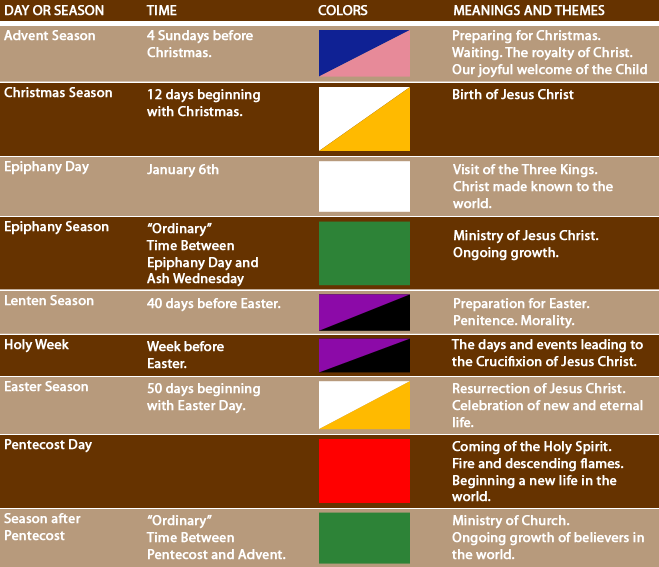
Using Colors and Seasons to Grow and Learn
The colors and decorations of the church change with the Church season and remind us that our Christian life is patterned on the life of Christ (birth, growth, death, resurrection) and that the landscape on our Christian journeys are subject to change (highs and lows).